Advertising Blimps for Fireworks Stands: The Complete Guide for Retailers Who Want More Traffic
The fireworks retail season runs 10 days. Every car that passes your stand without stopping is revenue you cannot recover. This guide covers what advertising blimps do for fireworks stand operators, what they cost, and how to calculate your return before you buy.
Why Visibility Is the Only Problem That Matters for Fireworks Stands
Fireworks stands sell a product that needs no explanation. Every adult in America knows what fireworks are. The purchase decision is almost never about product knowledge. It is about who the customer sees first.
Stands operate in a compressed window, typically June 24 through July 4, with a secondary window around New Year’s Eve. In that window, traffic volume and impulse purchasing are high. The stands that capture attention from the road convert browsers into buyers. The ones that blend into the roadside lose that traffic to a competitor located half a mile away.
This is the core problem that advertising blimps for fireworks stands solve.
The State of the US Fireworks Market in 2025
The US fireworks industry is large, growing, and under pressure at the same time.
Consumer fireworks consumption reached 295.3 million pounds in 2024, up from 246.5 million pounds the prior year, according to data published by the American Pyrotechnics Association. Revenue from consumer sales is projected to have exceeded $2.4 billion, a new record for the industry.
At the same time, retailers face a significant cost squeeze heading into 2025 and 2026. Approximately 96% of fireworks sold in the US are imported from China. In early 2025, tariffs on Chinese imports reached 145% before a temporary reduction to 30% following US-China trade negotiations. Major importers including Phantom Fireworks paused orders entirely during the peak tariff period. Industry analysts expect prices on roughly 30% of retail products to reflect some cost increase this season.
The practical effect for stand operators: tighter margins on product mean every customer who walks through your tent matters more. Foot traffic is not a vanity metric. It is survival math.
Key Fact
The APA and National Fireworks Association have formally requested tariff exemptions from the US Department of the Treasury and Customs and Border Protection. The industry’s lobbying position: fireworks cannot be manufactured domestically at scale, making tariffs effectively a tax on American consumers and small retailers.
What Advertising Blimps Do for a Fireworks Stand
A tethered helium advertising blimp floats 100 to 300 feet above your stand. From that height, it is visible to drivers a two miles or more down the road, giving them time to make a lane change and pull in. A roadside banner cannot do that. A flag cannot do that. A sign on a pole cannot do that.
The visibility mechanics work in your favor for several reasons:
First, the blimp is above the visual clutter of competing signs, trees, and vehicles. Drivers are looking ahead, not scanning the shoulder. A blimp at altitude enters their field of vision before anything at ground level.
Second, movement attracts attention. A blimp in wind shifts position constantly. Static signs fade into background noise. A moving object at altitude does not.
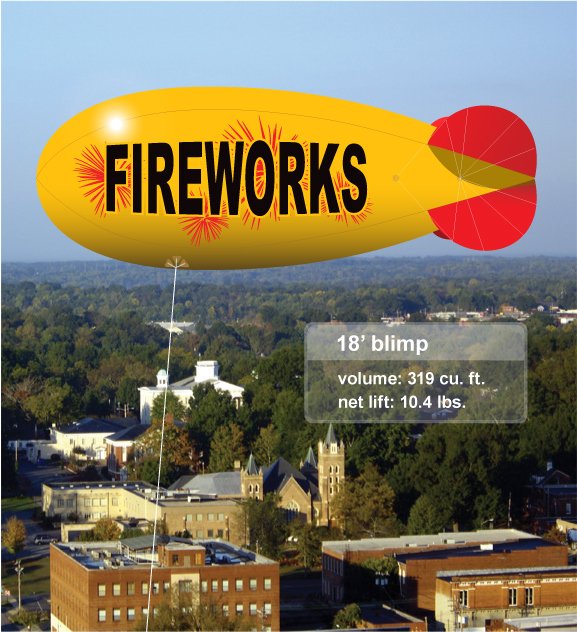
Third, custom lettering on the blimp delivers your message before the customer reaches you. “FIREWORKS” in large letters on a yellow blimp communicates exactly what you sell, in plain sight, with no ambiguity. Drivers make a decision to turn before they even read the small sign at your entrance.
Arizona Balloon Company’s own data and customer reports indicate traffic increases of 15 to 20% from blimp deployment at retail locations. For a fireworks stand doing $50,000 in a season, a 15% traffic lift represents $7,500 in additional gross revenue, assuming similar average transaction values across new and existing customers.
Polyurethane vs. PVC: Why the Material Matters
Not all advertising blimps perform the same way. The material determines how long the blimp stays inflated, how well it flies, and what your ongoing helium costs look like.
PVC blimps are heavier and leak helium faster. A PVC blimp needs significantly more helium to achieve the same lift, and it needs to be refilled more often over a multi-week deployment. In a tight selling season, a blimp that deflates overnight or requires multiple expensive helium refills is a liability, not an asset.
Polyurethane blimps use approximately one-third the helium of comparable PVC models. The material is lighter, more flexible, and retains helium for longer periods. For a fireworks stand deploying a blimp across a 10-day season, that difference is material. Helium is not cheap. Repeated refills across a selling window add real cost to a PVC blimp’s apparent price advantage.
Arizona Balloon Company has manufactured polyurethane helium blimps in the USA since 1979. Clients include NASA, the US Navy, JPL, and NIH, all organizations where material performance is non-negotiable. The same construction that meets aerospace and government standards is what goes on a fireworks stand.
Blimp Sizes for Fireworks Stand Use
Size selection depends on your stand’s location and surrounding terrain. A stand on a flat highway with long sight lines benefits from a larger blimp. A stand in a commercial area with obstructions needs enough height and size to clear the clutter.
The most common sizes for fireworks retail use:
The 13-foot blimp is the entry-level workhorse. It performs well in winds up to 25 to 30 mph, requires 170 cubic feet of helium, and stores in a standard residential garage. It works well for stands on secondary roads and residential corridors.
The 18-foot blimp carries 319 cubic feet of helium and produces net lift of 10.4 pounds. It is visible at greater distance than the 13-foot model and is appropriate for highway frontage stands where you need to reach drivers at speed.
The 21-foot and larger models are highway-grade visibility tools. The 21-foot blimp is visible from well over two miles. Stands on US routes or interstate access roads benefit from this scale.
Fireworks Stand Blimp ROI Calculator
Estimate your return based on your stand’s season revenue and blimp size.
$50,000 15%Revenue lift estimates are based on a 15-20% traffic increase reported by Arizona Balloon Company customers. Actual results vary by location, stand size, and local competition. Helium cost not included; polyurethane blimps require approximately one-third the helium of PVC alternatives.
How Long Does a Blimp Last?
A polyurethane blimp purchased from Arizona Balloon Company is not a seasonal consumable. With proper care, it lasts multiple years across multiple selling seasons. That is the key economic fact that separates blimps from other advertising spend.
A billboard rental in a mid-size US market runs $1,500 to $3,000 per month. That spending disappears when the contract ends. A one-time blimp purchase at a similar price point produces a physical asset you own, store, and redeploy every year. The cost-per-season drops with every additional season you use it.
Storage is straightforward. A 13-foot blimp fits in a standard garage. Deflated, cleaned, and stored in a cool, dry space away from sharp objects, a polyurethane blimp will be ready for the next season. Many operators report 5-plus years of use from a single unit.
What 2025 and 2026 Mean for Fireworks Stand Operators
Two factors make visibility investment more important heading into the next two seasons, not less.
First, tariff-driven cost pressure is real. Industry analysts and major importers have confirmed that price increases on 30% or more of product lines are possible in 2025, with larger effects potentially hitting 2026 orders placed during the current tariff uncertainty. When margins on product compress, volume matters more. The stands that move the most product survive margin compression better than those that do not.
Second, 2026 is the US Semiquincentennial, America’s 250th anniversary. Demand for consumer fireworks is expected to spike significantly. Retailers who build brand recognition and establish strong roadside presence in 2025 will be better positioned for that demand surge. A blimp purchased in 2025 is ready for deployment in 2026 with no additional investment.
Frequently Asked Questions
How high does a fireworks stand blimp fly? Tethered advertising blimps typically fly between 50 and 300 feet, depending on local FAA regulations and tether length. At 100 feet, an 18-foot blimp is visible to oncoming traffic from over two miles away on most roads.
Do I need a permit to fly a tethered blimp? FAA rules require notification for tethered balloons above certain heights in some airspace classes. Most stand locations are outside restricted airspace. Arizona Balloon Company can advise on the requirements for your specific location.
What happens in wind? Polyurethane blimps are rated for winds up to 25 to 30 mph depending on size. In severe conditions (thunderstorms, high gusts), bring the blimp down. The blimp does not fly in extreme weather, and neither should it.
What is on the blimp? You specify the lettering, colors, and artwork at the time of order. Standard packages include up to 13 letters per side in one color. Complex logos and custom artwork are available by quote. A “FIREWORKS” custom blimp in your brand colors is a common configuration for stand operators.
How long does it take to get a blimp? Arizona Balloon Company manufactures in the USA. Standard production and customization runs 2 to 4 weeks depending on complexity and current production schedule. Order well ahead of your season opening date.
Can I use the blimp for New Year’s Eve too? Yes. Fireworks stands that operate for both the July 4 and New Year’s Eve seasons get two deployments per year from a single blimp purchase, further reducing cost-per-season.
Comparing Advertising Options for a Fireworks Stand
Stand operators typically choose from the following advertising channels during the selling season:
Roadside signage. Standard signage is table stakes. Every stand has it. It works at close range for customers who are already slowing down. It does not attract attention from distance.
Digital and social advertising. Facebook and Google ads have measurable reach, but they require ongoing spend and audience targeting expertise. They drive awareness, not traffic to a specific physical location in a tight geographic radius.
Radio and print. Appropriate for large multi-location operators. For a single stand, the cost-per-customer is high and the channel requires lead time that does not match a compressed seasonal window.
Advertising blimps. One-time cost, deployed at the stand, visible without a customer taking any action. The blimp works on every car that passes your stand, every hour it flies, for the full season. No recurring cost. No ad platform. No targeting required.
The blimp’s advantage is that it reaches customers at the moment of decision. A driver passing your stand at 45 mph has approximately four seconds to notice your location and decide to turn. A blimp at altitude reaches that driver before they pass you. Digital ads reached them three days ago, when they were at home.
How to Order an Advertising Blimp for Your Fireworks Stand
Arizona Balloon Company manufactures polyurethane advertising blimps in the USA. All production happens at the Glendale, Arizona facility. Lead times are 2 to 4 weeks for standard configurations with custom lettering.
The ordering process is direct. Call 1-800-791-1445 or email sales@arizonaballoon.com with your stand location, preferred blimp size, and lettering specifications. The team will confirm production time and provide a full quote including any artwork or custom color work.
Blimps are available in sizes from 10 feet to 30 feet. Prices start at $946 for a base 13-foot model and $1,526 with custom lettering. The 18-foot blimp with lettering, the size shown in the image at the top of this page, is $2,127.
Ready to Put a Blimp Over Your Fireworks Stand?
Arizona Balloon Company has manufactured polyurethane advertising blimps in the USA since 1979. All blimps are built in Glendale, Arizona from US-made materials. Call or order online for your fireworks season deployment.
Get a Quote at FireworksBlimps.comSee more at ArizonaBalloon.com.
Call 1-800-791-1445 for your Fireworks Blimp.
Email: Sales@ArizonaBalloon.com.